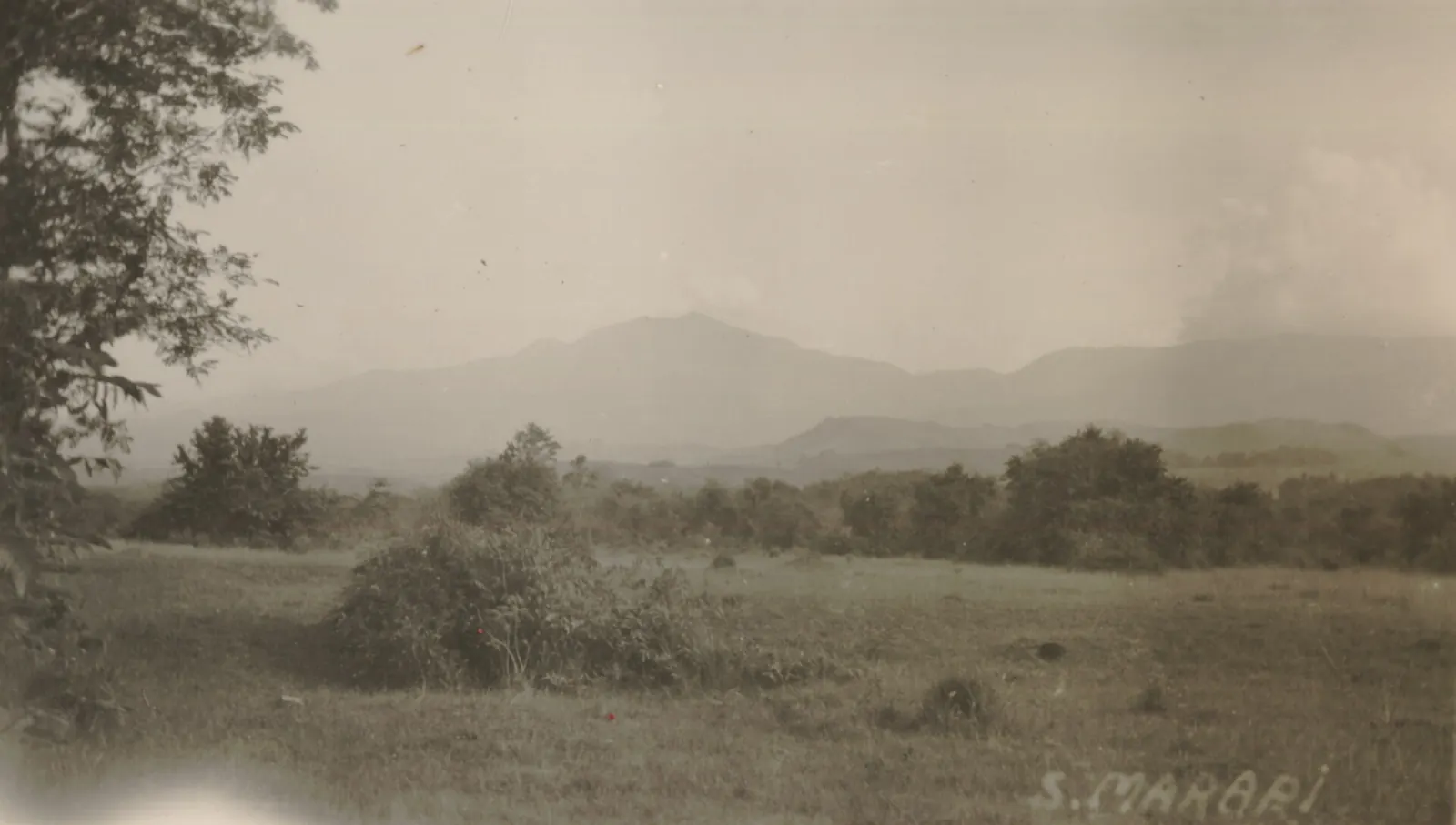
Sorik Marapi volcano
The highest point of Batang Gadis National Park: an active volcano with a lake in its crater.
Sorik Marapi is an active volcano, 2,145 metres high, in Puncak Sorik Marapi district of Mandailing Natal. Its crater holds a volcanic lake. Eruptions are recorded in 1830, 1879, 1892, 1893, 1917, 1970, 1986 and 1987. In the last one, ash and hot mud flowed as far as Pasaman Regency in West Sumatra. The volcano observation post is in Sibanggor Tonga village.
The photo above was taken in the colonial period from the direction of Kotanopan (then Hoetanopan). The cone looks much the same today.
Why the alert was raised
Seismic activity rose in April 2026, and the Geological Agency raised the level to Alert. On 18 July 2026, between midnight and 18:30, seismographs recorded 40 deep volcanic earthquakes, but no shallow quakes or surface activity. The agency also warns people to keep away from the Sibanggor Tonga and Sibanggor Julu craters and other active vents, which can suddenly throw out mud and toxic gas.
The trail (once it reopens)
The usual route starts in Sibanggor Julu at about 950 m. Hikers typically reach the crater rim in 3½–4 hours and come down in about 3. The path goes through rubber gardens, a sulphur area, then forest, and is barely marked.
- Report to the village head of Sibanggor Julu before you climb. The village has its own rules and customs, including on guides and fees.
- Carry plenty of drinking water: water on the slopes is heavy with sulphur.
- Activities inside the conservation area also need a permit from the park office. See the visitor guide.
The times above come from hikers' reports from before 2026. Conditions may be different once the trail reopens.
Geothermal wells and toxic gas
Since 2013 a geothermal power project, PT Sorik Marapi Geothermal Power (SMGP), has operated on the volcano's slopes. On 25 January 2021 five residents of Sibanggor Julu died after inhaling toxic gas near one of its wells, and dozens were hospitalised. More gas poisonings followed in 2022 and 2024.
Stay away from wellpads and pipelines, follow warning signs, and move away at once if you smell a strong rotten-egg odour.